Pet mesh flyscreens and when they are worth it
What pet mesh is made of, how much tougher it is than standard mesh, what it costs, how it affects airflow, and whether you can fit it yourself.
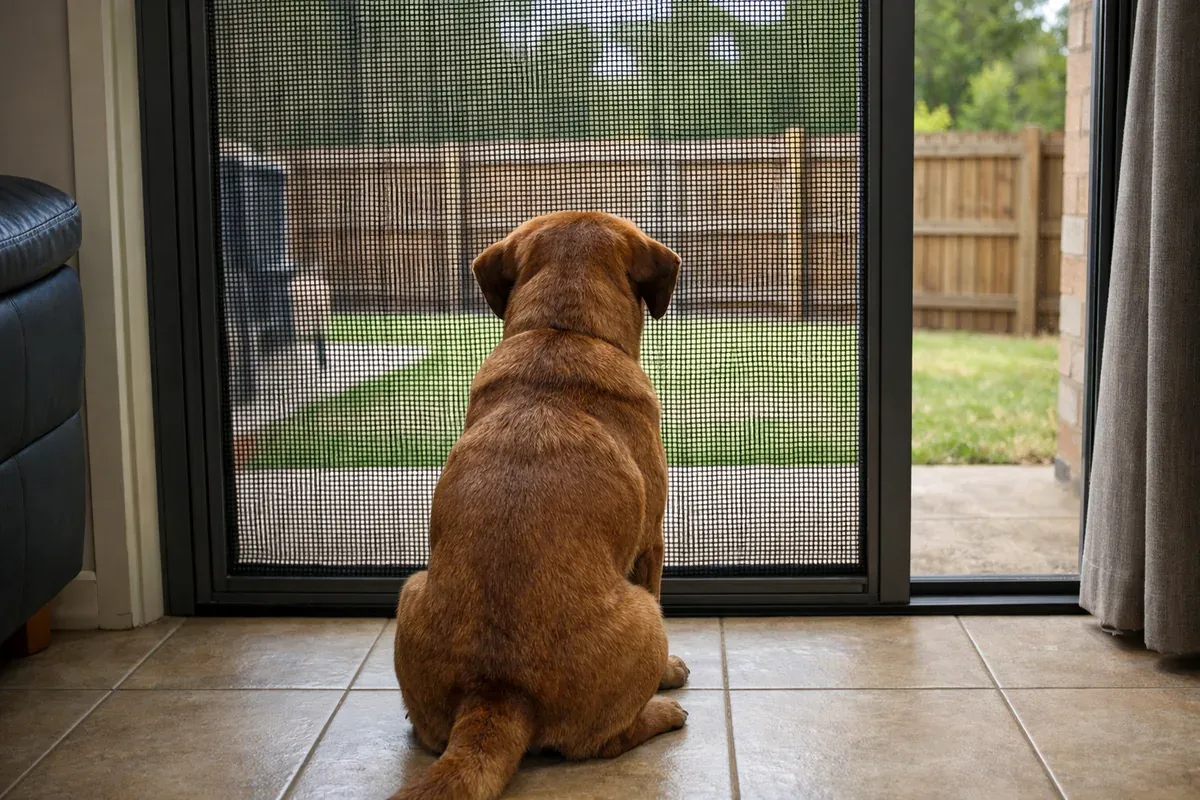
Pet mesh is a thick, heavy-gauge polyester flyscreen mesh made to stand up to claws and paws. It is far more tear resistant than standard fibreglass (Bunnings lists Cyclone’s version as about six times stronger), costs roughly double for the mesh itself, and lets noticeably less air and light through. It is worth it on doors and low windows where a dog or cat scratches, but it will not stop a dog that charges the screen.
What pet mesh is made of
Standard flyscreen in Australia is usually fibreglass: thin coated strands that are cheap and easy to work, but tear easily when a claw catches them. Pet mesh uses much heavier polyester strands, so it is far harder for a claw to tear.
The difference shows up in the specs. Lincoln Sentry, an Australian supplier to screen makers, listed its standard Flypro fibreglass mesh at 0.25 gauge with an 18 by 14 weave, and its Flypro Pet-D-Fence pet mesh at 0.66 gauge with a 15 by 11 weave (the Flypro listings are now marked discontinued, but the figures show the difference). So the strands are more than twice as thick, and there are fewer of them per inch.
Pet mesh is sold under different names, such as Cyclone Pet Mesh at Bunnings and PetScreen from the US maker Phifer. This guide is about the heavy polyester kind most people mean.
How much stronger is it, in practical terms
The honest answer is that strength figures come from the people selling it. Bunnings’ listing for Cyclone 1220 mm x 2 m Pet Mesh says it is about six times stronger than fibreglass and tear resistant against scratching from most dogs and cats. Lincoln Sentry is more cautious and says its pet mesh “may reduce” damage from most dogs and cats compared with traditional flyscreen. Neither publishes a test method, so treat the multiplier as a rough guide.
In plain terms, here is what that means:
- Claws and paws: this is what it is built for. A cat scratching or a dog pawing to be let in is much less likely to rip a hole.
- Kids pushing on it: Bunnings describes it as suited to high-traffic doors where paws or small hands push against the screen.
- A full impact: the mesh itself may survive, but it is still held in by a rubber spline in a channel. A heavy dog jumping at it can pop the spline out or bend a light aluminium frame.
- Security: none. Pet mesh can be cut with a knife like any flyscreen.
Pet mesh versus standard mesh at a glance
| Standard fibreglass | Pet mesh | |
|---|---|---|
| Material | Coated fibreglass | Heavy-gauge polyester |
| Thickness (Flypro specs) | 0.25 gauge | 0.66 gauge |
| Airflow (Flypro specs) | 71% | 44% |
| Claw resistance | Low | High (maker’s claim) |
| Bunnings price, 1220 mm x 2 m | About $16 | About $35 |
| Ease of fitting | Easy | Harder, may need thinner spline |
Prices checked on bunnings.com.au in November 2026. Airflow and thickness figures are from Lincoln Sentry’s Flypro listings; other brands will differ.
Effect on view and airflow
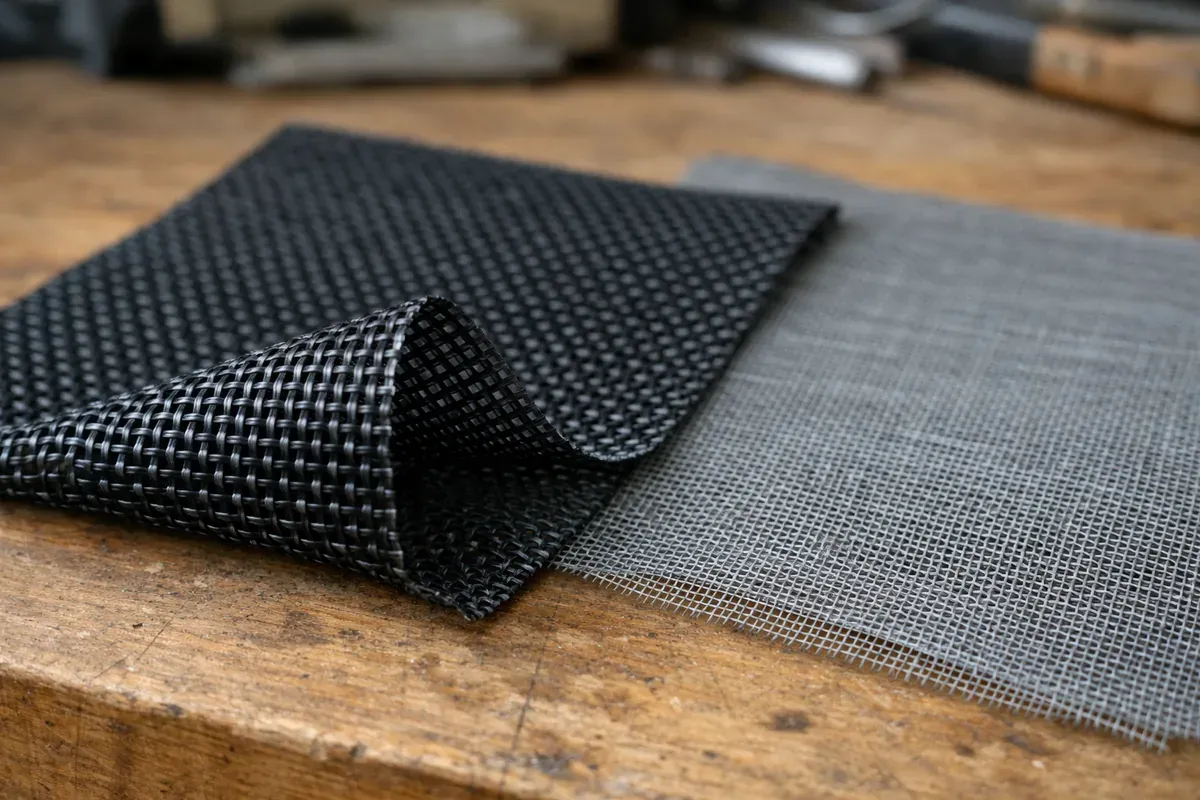
You will notice the difference. Lincoln Sentry’s figures put airflow through its pet mesh at 44%, against 71% for its standard fibreglass. That is a real drop in breeze on a hot night, so think twice before putting pet mesh on every window. A Perth screen business also notes on its price page (undated, checked November 2026) that pet mesh lets less light through.
The view out is darker and slightly coarser, a bit like looking through a fine black fabric. Most people find it fine on a back door. On a window you look through often, standard fibreglass or a clearer mesh will be nicer. Our guide to flyscreen mesh types compares the other options.
Because the weave is coarser, pet mesh is not the right pick if midges or sandflies are your main problem.
What it costs
DIY: in November 2026, Bunnings listed a 1220 mm by 2 m piece of Cyclone pet mesh at about $35. The same size in Cyclone fibreglass was about $16.
Getting it done: on new screens, the businesses we checked add about $50 to $140 per screen for pet mesh, according to their published price lists (checked November 2026). One adds about $70 on a window screen, and a Sydney business lists pet mesh at $140 extra on a door. A Perth business’s undated price page lists pet mesh on a standard flyscreen door from $159 plus GST. Prices vary by city, screen size and how many you do in one visit. Our cost calculator gives a rough range for your screens.
Can you fit pet mesh to your existing frames
Usually, yes. If the frame is straight, the corners are tight and the spline channel is not damaged, pet mesh goes in the same way as any other mesh. The difference is the spline.
Because pet mesh is so much thicker, the spline that held your old fibreglass may be too fat to roll in over it. If you force it, you can tear the mesh or bow the frame. US mesh maker Phifer’s spline sizing guide says its PetScreen needs one size smaller spline because of the thickness of the fabric. That is one maker’s guidance for its own product, and no Australian source we found states the same rule, so test fit before you do the whole screen.
What you need
- Pet mesh, cut with a generous margin past the frame on every side
- New spline, probably thinner than the old one (take a piece of the old spline to the shop, and consider buying two sizes to test)
- A spline roller, ideally with a concave wheel for the second pass
- A sharp utility knife with a fresh blade
- Clamps or weights to hold the frame flat
Tips that help with thick mesh
- Pull out the old spline and check its diameter before you buy anything.
- Test the new spline on one corner first. It should roll in firmly without you leaning your full weight on the roller.
- Roll the mesh into the channel with the convex wheel, then the spline with the concave wheel.
- Keep the mesh snug but do not over-tension it. Pulling too hard can bow the long sides of a frame inwards.
- Trim the excess with the blade angled away from the mesh, and keep fingers clear.
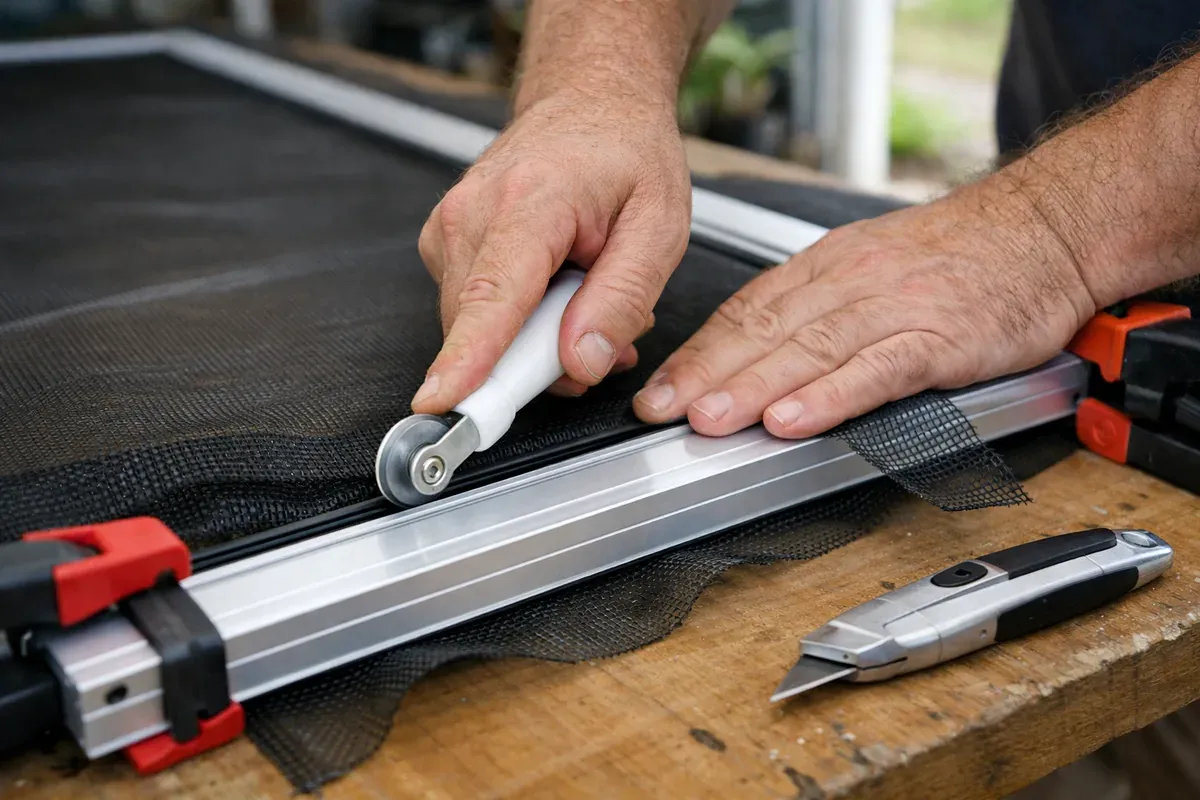
The full step by step method is in our guide to replacing flyscreen mesh, and our spline sizes guide explains how to match spline to channel. Work on a bench, not on a ladder, and take care with upper floor screens.
Where pet mesh will not help
- A dog that charges or jumps at the door. The weak point becomes the spline and the frame, not the mesh. Expect the mesh to pop out of the channel or the frame to bend.
- Cats that climb. The makers claim resistance to scratching, not to a cat hanging its full weight off the screen. Climbing loads the spline and the corners, and the mesh can stretch or pull free.
- Security. It is still flyscreen. If you need the door to keep people out, you need a proper security screen door.
- A bent or loose frame. New mesh will not fix a frame that is already out of square.
Alternatives worth considering
A flyscreen pet door. Bunnings’ pet door guide describes flyscreen pet doors that clamp onto your existing screen, with a magnetic flap that lets the animal through and keeps insects out. If your pet scratches because it wants to get in or out, this often solves the real problem. For a sliding door there are also self-contained panels that sit in the track.
A guard on the lower part of the door. Some screen businesses fit a clear perspex guard across the lower part of a screen door, where most scratching happens. The Perth business mentioned above lists one at $29.50 fitted on its undated price page. Ask a local screen business what it offers.
A security screen door. For a big dog that throws itself at the door, a security door with stainless steel mesh in a strong frame is the real fix. It costs much more, but it is built to take impact. Our guide to flyscreen doors compares the types and costs.
When to get someone in
Get a screen business to do it if the frame is bent or a corner is cracked, if the screen is a large sliding or hinged door (pet mesh is heavy and hard to tension evenly on big panels), or if the screens are on an upper floor and need to come out from outside. A pro can also tell you whether a pet door or guard panel would suit your door better than new mesh.
You can find a local screen business or ask for a quote and choose pet mesh as the job type.
Questions
Is pet mesh dog proof?
No. It resists scratching and pawing from most dogs and cats, which is what the makers claim, but a dog that jumps at or runs into the screen can still push the mesh out of its channel or bend the frame. For that you need a stronger door, not just stronger mesh.
Can I put pet mesh in my existing flyscreen frame?
Usually yes, if the frame is straight and in good shape. Pet mesh is much thicker than fibreglass, so you may need a thinner spline than the one that came out (one mesh maker advises one size smaller). Test it on one corner before doing the whole screen.
Does pet mesh keep out mosquitoes?
It keeps out most flying insects, but the weave is coarser than standard fibreglass, so it is not the choice for midges or sandflies. If tiny biting insects are your main problem, look at midge mesh instead.
How much more does pet mesh cost than normal flyscreen?
At Bunnings in November 2026 a 1220 mm by 2 m piece of Cyclone pet mesh was about $35, against about $16 for the same size in fibreglass. On new screens, the screen businesses we checked add about $50 to $140 per screen for pet mesh.