How to measure for a flyscreen or screen door
Measure windows, sliding and hinged screen doors in millimetres, apply the right deductions, and send a screen business what it needs to quote.
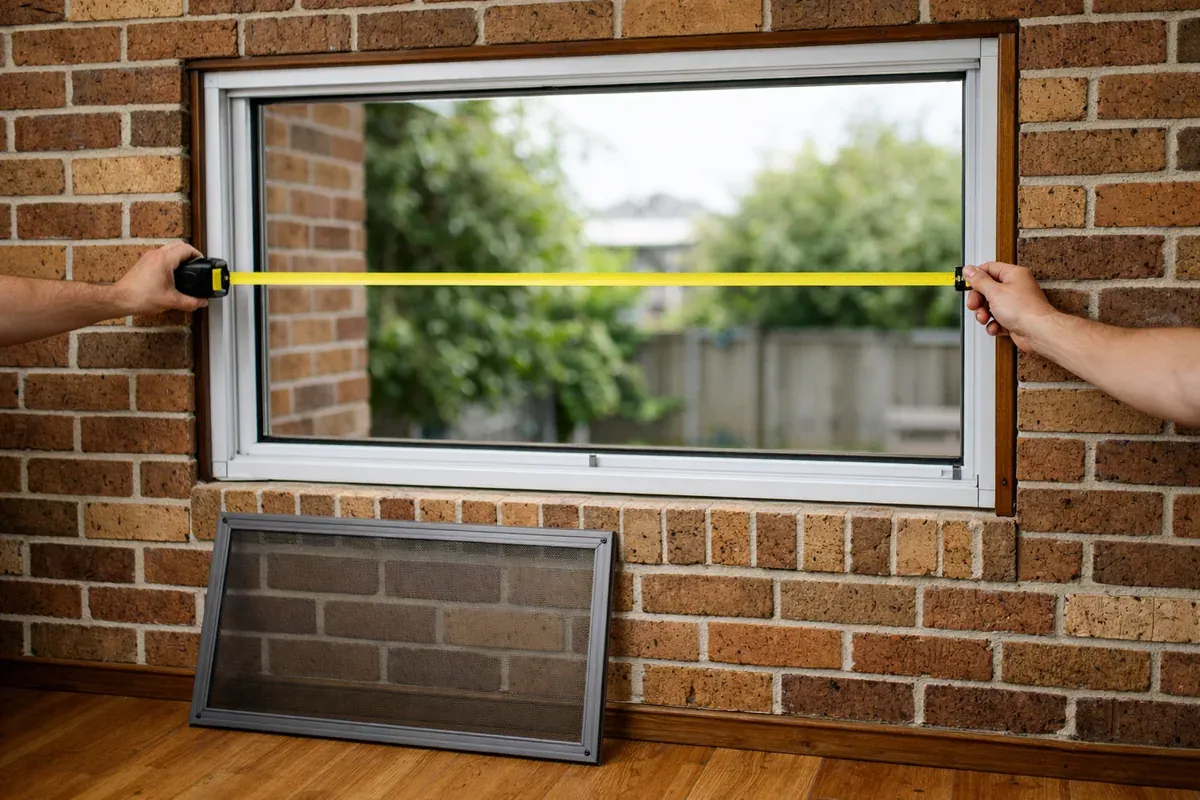
Measure in millimetres. Take the width at the top, middle and bottom and the height at the left, centre and right, and use the smallest of each. If you still have the old screen and it fitted well, measure the screen itself. If you don’t, measure the opening and apply the deduction your supplier asks for, which depends on whether the screen sits inside the recess, on the face of the frame or in a track.
What you need
- A metal tape measure that reads in millimetres
- A short solid ruler for the channel or recess width
- Your phone, for notes and photos
Measure upper floor windows from inside. Don’t lean out of a window or work off a ladder to get a measurement: a screen business can do those on site.
Measuring the old screen when you have it
A well fitting, unbent old screen is the best template you have. Take it out first (our guide on how to remove a flyscreen covers sliding, awning and double hung windows).
- Lay the screen flat on the floor or a table.
- Measure the width across the outside edge of the frame at the top, middle and bottom.
- Measure the height at the left, centre and right.
- Write down the smallest width and smallest height.
- Measure the thickness of the frame edge with a solid ruler (see the 9 mm and 11 mm note below).
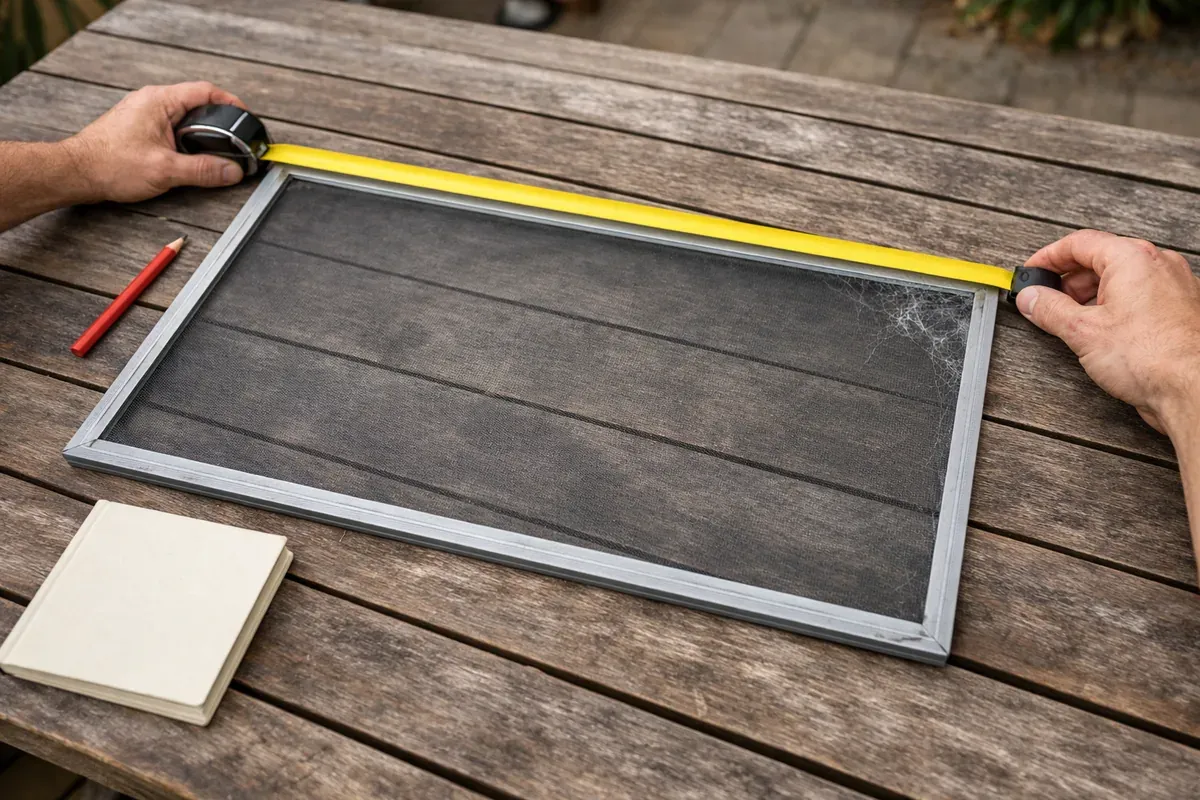
If the screen is bowed or badly damaged, measure the opening instead. Seconline, an online screen supplier, asks customers to call if the top and bottom widths of an old screen differ by more than 3 mm; Screen Warehouse in Sydney uses 4 mm.
How to measure for a flyscreen without the old screen
First work out how the screen fits. There are three common ways:
- Recess fit (also called loose fit): the screen sits inside a channel or recess in the window frame and is held by its own fit or by plunger pins.
- Face fit: the screen sits over the opening on the flat face of the frame, held by clips or turnbuckles.
- Track fit: the screen slides into a track, as on many sliding windows.
Then measure the clear opening at three points each way and apply your supplier’s rule. These are the published rules of three Australian made-to-measure suppliers (checked November 2026), not an industry standard:
| How it fits | Where you measure | What suppliers ask for |
|---|---|---|
| Recess or loose fit | Inside the recess, inner face to inner face | Take off 2 mm (Flyscreens In A Box, Seconline) or 2 to 3 mm (Screen Warehouse) for fitting clearance |
| Face fit | The clear opening on the face of the frame | Flyscreens In A Box adds 40 mm to each (a 20 mm overlap on every side), and needs at least 20 mm of flat frame around the opening |
| Track fit | Between the track lips | Flyscreens In A Box adds the depth of the deeper track, then takes off 3 mm |
Worked example of that track fit rule: a clear width of 865 mm with a side track 8 mm deep gives 865 + 8 minus 3, so an 870 mm screen.
For a recess fit, Seconline’s method is to measure from the lip on the shallower side across to the full depth of the deeper side, then take off the 2 mm.
The rule that catches people out
Flyscreens In A Box and Seconline both say they make the screen to exactly the size you enter, so the deduction is your job. A local screen business that measures for you works out its own allowances. When you send measurements to anyone, say clearly whether they are the opening size or the finished screen size, so nobody takes the deduction off twice.
9 mm or 11 mm frame
Most Australian window flyscreens use an 11 mm thick frame, and a 9 mm frame is made for narrower channels. Seconline and Screen Warehouse both warn that an 11 mm frame only fits a recess wider than 11 mm, so measure the channel with a solid ruler before you order. Flyscreens In A Box notes that 9 mm channels are common on Bradnam’s and A&L windows.
Awning and casement windows
On windows with a chain winder, the screen has to sit above the winder, so Flyscreens In A Box has you measure the height from that raised level. It also requires a mid rail on screens over 1200 x 1200 mm.
Measuring for a sliding screen door
Seconline’s sliding screen door measuring guide sets out its own rules:
- Existing door that fits well: measure the width at the top, middle and bottom and use the largest; measure the height on both sides and use the shortest.
- New door into existing tracks: measure the height at three or four points between the tracks and take 12 mm off the shortest reading. If the readings vary by more than 4 mm, the door may not slide properly and the tracks may need work.
- Lock side: stand outside looking in and note whether the handle is on the left or the right.
The width rule for an existing sliding door (use the largest) is the opposite of the window rule. If your rollers or track are the real problem, see our sliding flyscreen door repair guide before buying a new door.
Measuring for a hinged screen door
Seconline’s hinged door measuring guide has you measure the door jamb at the top, middle and bottom and take 8 mm off each width for a single lock door (9 mm for a triple lock), then measure the height on both sides and take 8 mm off the shorter one. Note which side the lock goes on (standing outside) and check there is enough rebate, the flat step in the frame, for a screen door to sit in.
Those are one supplier’s deductions for its own doors. Other makers use different hardware and allowances, so follow the guide of whoever is making yours. For a security screen door, have the supplier measure, and ask in writing which Australian Standard the door was tested to: the label “security door” on its own proves nothing. Our flyscreen doors guide compares the types.
Check whether the opening is square
A screen frame is built square, so an opening that isn’t leaves gaps on one side.
- Compare your three width readings. Then compare your three height readings.
- Measure both diagonals, corner to corner.
- If the diagonals match within a few millimetres, the opening is close to square.
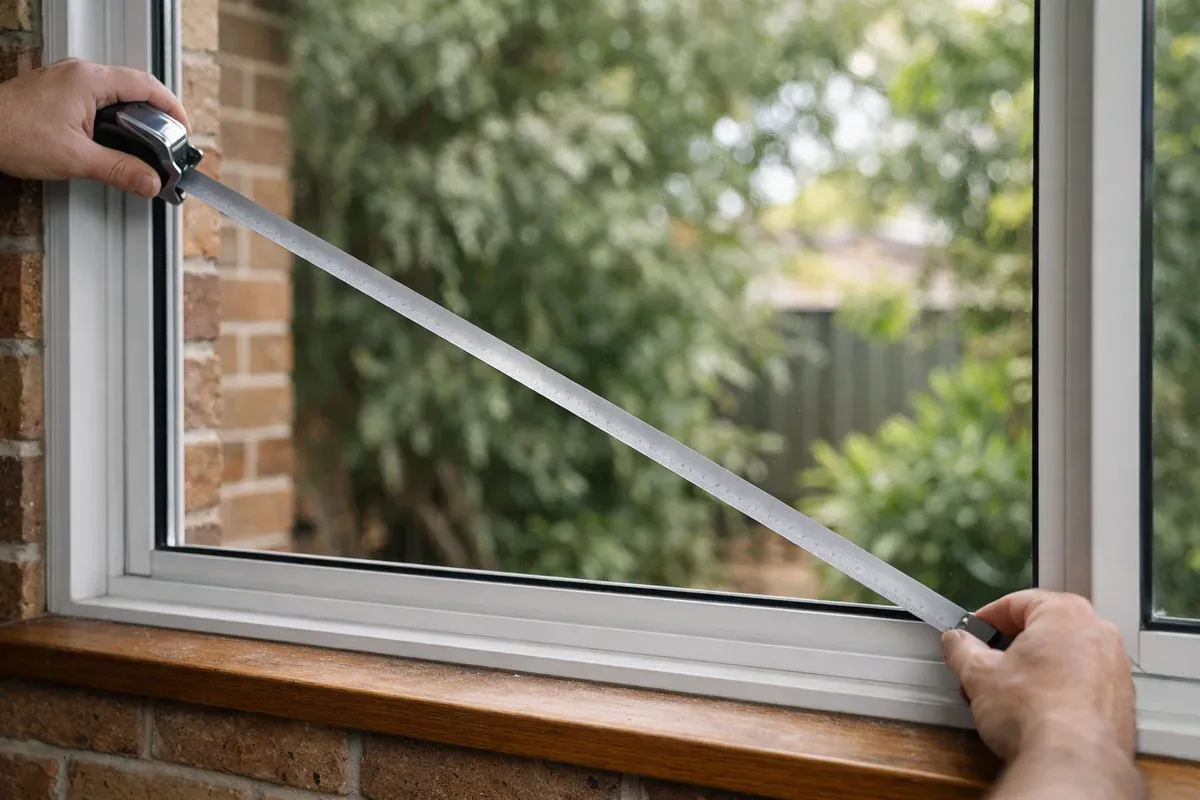
Write the spread down (for example “widths 865, 867, 864”). If readings differ by more than 3 or 4 mm, tell the business; it may suggest a different fit or come out to measure.
Note the frame colour, mesh and fixings
Measurements alone aren’t enough to quote. Note these too:
- Frame colour: match it to your window frames (Flyscreens In A Box lists 23 frame colours). If you don’t know the name, a clear photo next to the window frame is fine.
- Mesh: standard fibreglass, or pet, midge, aluminium or stainless mesh. Our flyscreen mesh types guide explains the differences.
- Fixing type: recess, face or track fit, and what holds it (plunger pins, clips, turnbuckles, or nothing).
- Frame thickness: 9 mm or 11 mm.
What to send a screen business for a quote
A business can often quote a standard screen from a message and photos. Send this for each screen or door:
- Where it is: for example “kitchen window” or “back sliding door”, and which floor.
- What it is: window flyscreen, sliding screen door or hinged screen door, plus the window type (sliding, awning, double hung, fixed).
- New or repair: a new screen, a new frame, or a remesh of the existing frame.
- Size in millimetres: width x height, smallest readings for windows, labelled W and H. Say whether you measured the old screen or the opening.
- Your three readings each way if they vary by more than a few millimetres, and the diagonals.
- How it fits: recess, face or track, and 9 mm or 11 mm frame if you know.
- Frame colour: the name if you know it, or a photo.
- Mesh type: standard, pet, midge, stainless or other.
- For doors: lock side (from outside), single or triple lock, and the condition of the track or jamb.
- Photos: one wide shot of each window or door, and one close up of a corner showing the frame and channel.
- Your suburb and postcode, and whether you need it fitted or will fit it yourself.
Tell them how many screens in total. You can put all of this in the details box on our quote form.
When to get someone in
Measuring a single ground floor window screen is an easy DIY job. Get a screen business to measure when:
- the screens are on an upper floor, or out of reach without a ladder
- the opening is out of square, bowed or damaged
- you’re ordering a security screen or security door
- you’re doing a whole house and don’t want to wear the cost of a wrong order (Seconline and Screen Warehouse both say they won’t replace a screen ordered with the wrong frame)
- a sliding door’s track is worn or uneven
Ask whether the business charges to measure and quote. Request a quote and we’ll pass your details to a local screen business, or find screen businesses near you. For a rough idea of the price first, try the flyscreen cost calculator.
Questions
Do I take anything off my measurements before ordering a flyscreen?
It depends on the supplier and how the screen fits. Online made-to-measure suppliers generally make exactly the size you enter, so you apply their deduction yourself (often about 2 mm for a screen that sits inside the recess), while a local screen business that measures on site works out its own allowances.
Do I write the width or the height first?
Width first, then height, is the usual order (for example 865 x 1048). Label each figure W or H anyway, so there is no mix up.
Can I just measure my old flyscreen?
Yes, if it fitted well. Measure the outside edge of the frame at both ends and in the middle, and use the smallest width and smallest height.
Why measure in three places?
Window and door frames are rarely perfectly straight. Measuring at three points shows you the tightest spot, and a screen made to that size will fit everywhere.
What if my window or door frame is out of square?
Note how big the difference is and tell the screen business. A few millimetres is common, but suppliers ask you to contact them when readings differ by more than about 3 to 4 mm, and a badly out of square opening is a good reason to have someone measure on site.