How to remove a flyscreen without bending it
How to get a flyscreen out of sliding, double hung, awning, casement and louvre windows, plus a sliding screen door, and how to put it back.
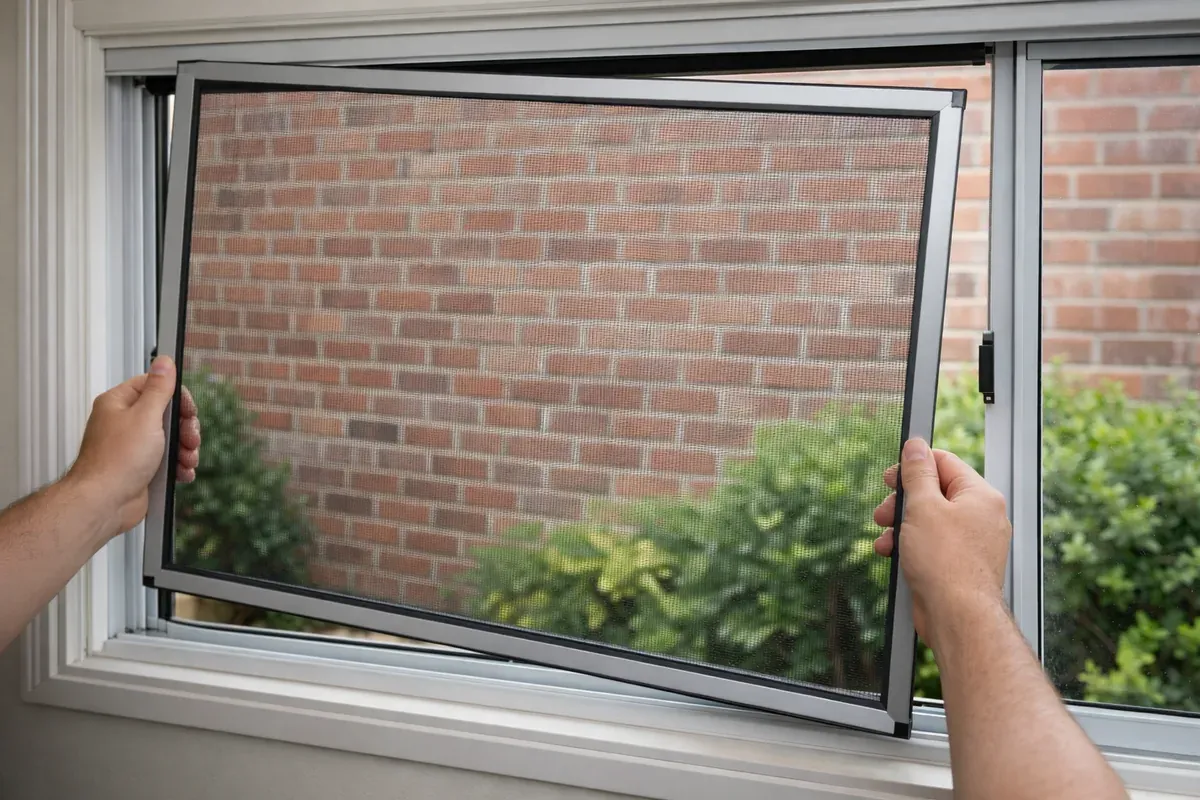
Most flyscreens come out in one of two ways: you release the fixings (clips, turn buttons, plunger pins or screws), or you lift the screen up into the top track and swing the bottom out. Which one you need depends on the window. Sliding, awning, casement and louvre screens usually come out from inside the house; many double hung screens sit on the outside.
The rule that saves the frame: if the screen does not move with gentle pressure, something is still holding it. Find it before you push harder.
What you need
- A flat screwdriver or a plastic paint scraper (for clips and gently easing a frame)
- A Phillips screwdriver (for screwed clips and turn buttons)
- A dry paintbrush or vacuum to clear the track
- Masking tape and a pen to label each screen
- A second person for large screens and sliding doors
Label every screen with the room and window as it comes out. A Melbourne screen seller interviewed by ABC News recommends this so screens don’t end up in the wrong windows, and says he regularly does work for people who have mangled their screens taking them out to clean the glass.
Work out how your screen is held
Look around all four edges of the frame, inside and outside, before you touch it.
| Fixing | What it looks like | How to release it |
|---|---|---|
| Spring clips | Small metal clips on the frame edge | Press or flick the clip back off the screen frame |
| Turn buttons or turn clips | Small tabs screwed to the window frame that overlap the screen | Rotate each one off the screen; loosen the screw if it is too stiff |
| Plunger pins | Spring-loaded pins on the screen’s side or top edge | Press both pins in at once, then tilt the screen out |
| Lift-and-drop (track) | Screen sits in a top and bottom channel, often with a pull tab | Push the screen up into the top track, swing the bottom out, lower it |
| Screws or rivets | Screw heads or rivets through the screen frame | Unscrew; leave rivets alone unless you are replacing the screen |
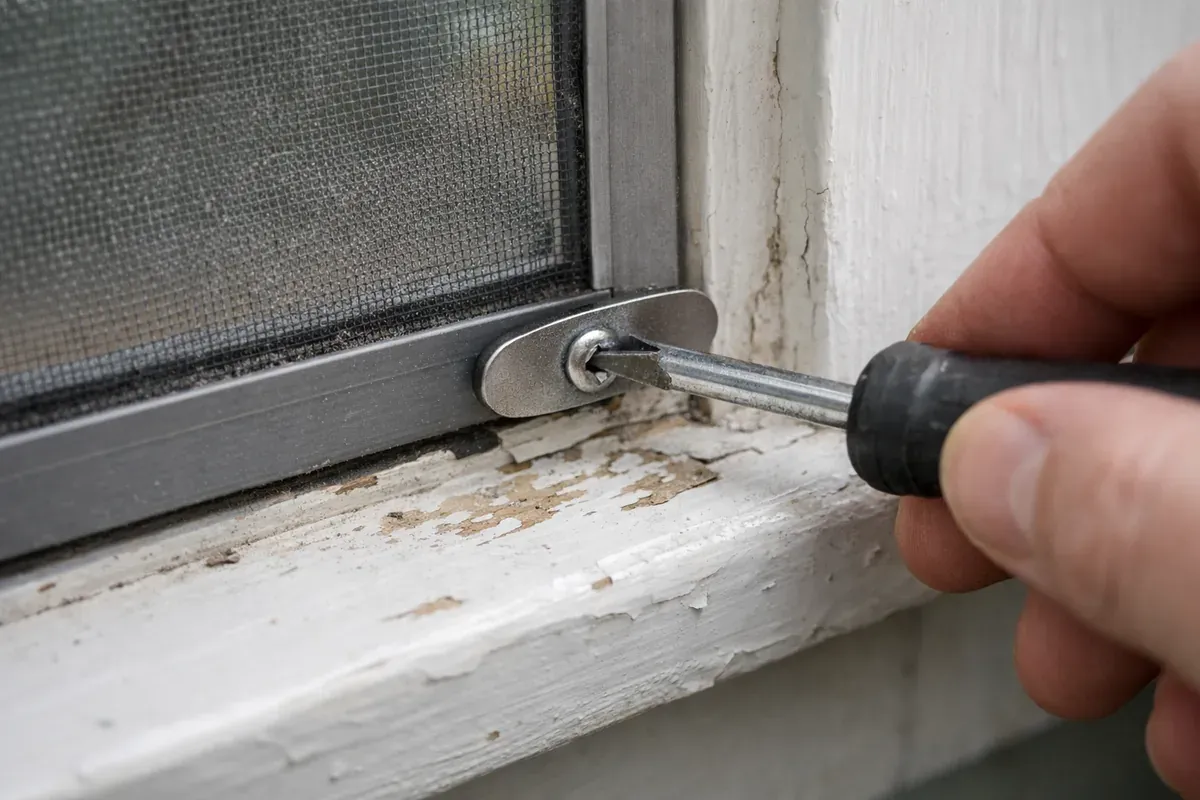
If you can see none of these, check the top track for a security block, or a screw through the head of the frame. These stop the screen (or a sliding sash) being lifted out from outside.
Sliding aluminium windows
On most sliding windows the screen sits in the outer track over the opening side and comes out from inside. A&L’s own instructions for fitting a screen to its sliders have the screen dropped onto small blocks in the outer track, its edge guided into the side jamb, and the top corners pushed up into the head (A&L sliding window guide). Removal is that in reverse.
- Slide the opening pane fully open so you can reach the screen.
- Release any spring clips on the screen edge.
- Hold both sides of the screen (or its pull tab) and push it straight up into the top track.
- Swing the bottom edge in towards you until it clears the bottom track.
- Lower the screen down and out, tilting it to fit through the opening.
On some windows the gap is too tight with the sliding pane in place. A&L’s fitting guide has you take the inside sash out first: lift it up into the head (clear of the security block), tilt the bottom towards you and lift it out. Only do this on a ground floor window with someone helping, because a glass sash is heavy.
Double hung windows
Many Australian double hung windows have the screen on the outside, held by clips screwed to the jambs. A&L’s instructions for its double hung windows say to rotate all the clips so the screen is free, and to loosen or remove the screws if the clips are too tight (A&L double hung guide). The screen sits on the sill, so support the bottom as the last clip turns.
Some double hung screens use plunger pins or spring tension instead. With pins, press both in together, tilt the top towards you and lift the screen out. With a spring-loaded screen, push it up to compress the spring, pull the bottom towards you and angle it out.
Awning and casement windows (wind-out)
Awning windows open outwards on a winder, so the screen has to sit inside. A&L fits its awning screens onto two small skirts either side of the winder and holds them with a clip screwed into each side of the frame. To take one out, use the tab on the screen to gently pull it out of place (A&L awning guide).
- Close the window first. It keeps the winder and chain out of the way while you work.
- Turn or flick back the clips or turn buttons on each side.
- Pull the top of the screen towards you using the tab.
- Lift the bottom off the skirts or ledge around the winder and bring the screen into the room.
If the chain or arm passes through a slot in the screen, you may need to wind the window part way open, or unscrew the chain from the sash, before the screen comes free. Screw it back firmly afterwards. Some screens on winder windows are screwed in permanently; if you see screws through the screen frame, it is a fixed screen.
Casement windows (hinged on the side, opening outwards) work the same way: screen inside, usually held by clips or turn buttons on the frame.
Louvre windows
Louvre screens normally fit on the room side because the blades swing outwards. Breezway’s technical bulletin for its Innoscreen louvre system describes screens fitted to the interior of the window, held in channels on the side posts with a leg at the head and sill to brace them (Breezway bulletin). Other louvre screens are held by clips or turn buttons.
- Close the louvres fully so no blade hits the screen.
- Release any clips or turn buttons.
- Lift or tilt the screen out of its channel, top first if it is held at the head.
Sliding screen doors
A sliding screen door hangs on rollers in a bottom track and is kept on by the top track. Most come out like this:
- Slide the door to about halfway.
- Remove anything in the top track that stops it lifting, such as a stop, guide or anti-lift block (usually a screw or two).
- Find the roller adjusting screws at the bottom corners of the door and turn them to lower the rollers. The direction varies between doors, so turn a little at a time and watch whether the door drops.
- With a helper, lift the door up into the top track.
- Swing the bottom towards you, clear of the bottom track, then lower the door out.
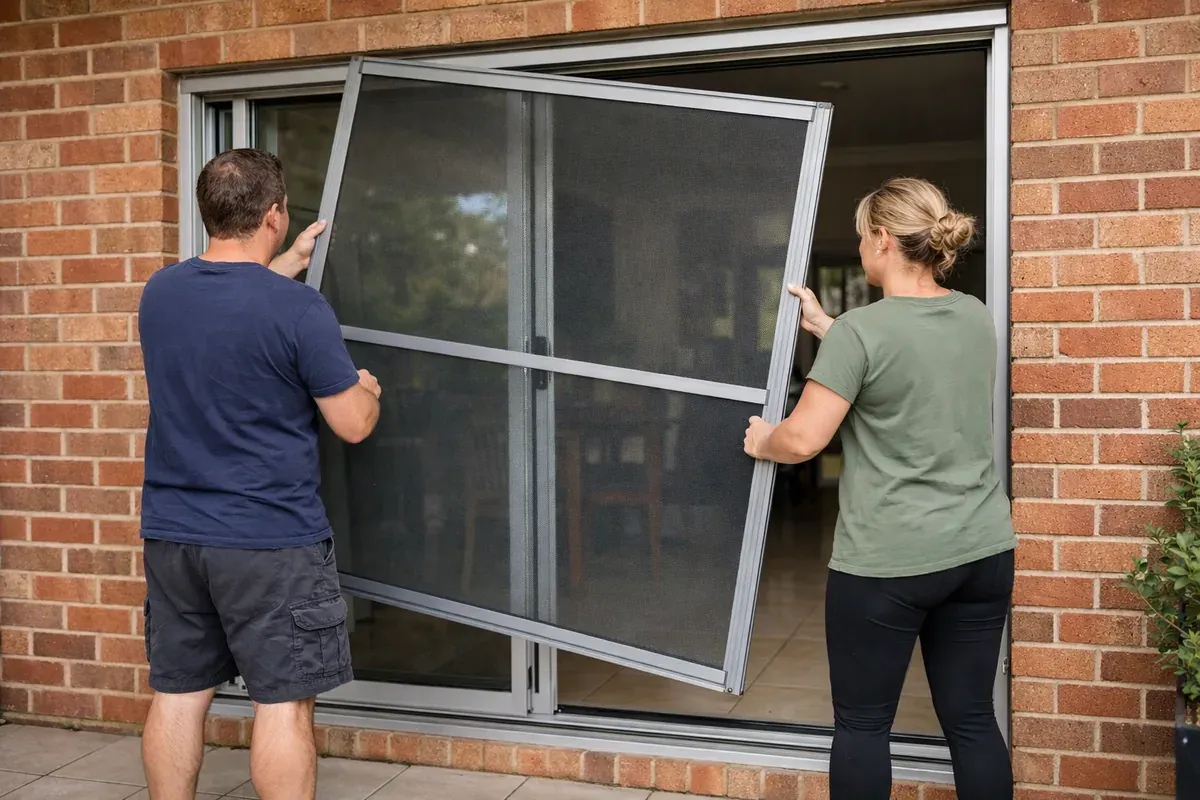
To refit, put the top in first, lift, drop the bottom rollers onto the track, then raise the rollers until the door glides without catching. Our sliding screen door repair guide covers worn rollers and bent frames.
Screens that only come out from outside
Outside-fitted screens (common on double hung windows) need you outside the house. On a ground floor that is fine. Above it, you are on a ladder leaning towards a window, which is where people get hurt. If you cannot reach the screen from a balcony or from inside, leave it in place and clean it there, or get a screen business to do it.
Upstairs windows and children
Work from inside wherever you can, and never lean out of an upper window to reach a screen. With the screen out, the window is just an open hole: keep children away from it until the screen is back. Even with the screen in, Campbelltown City Council’s child safety page warns that fly screens are not a strong enough barrier to stop a child falling, and recommends window locks that limit the opening to 12.5 centimetres.
How to put the screen back
- Clean the track with a dry brush or vacuum so the screen seats properly.
- Check you have the right screen for the window (the label helps).
- Fit it the way it came out, in reverse: top into the head first for track screens, then drop the bottom into place.
- Re-engage every clip, turn button or pin, and check the screen sits flat with no light showing around the edges.
- Refit any security block, stop or screw you removed.
If a clip is missing or broken, replacement clips are sold by window brand, and some only suit windows from a certain year on, so take the old one with you when you buy.
When to get someone in
Call a screen business if the screen can only come out from an upper floor outside, if it is screwed or riveted into a security screen frame, if it is already bent, or if the sliding door will not come out after you have lowered the rollers. If you are taking the screen out to fix torn mesh, our remeshing guide takes you through it, and the cost guide and cost calculator show what a repair usually runs to. You can find a local screen business or ask for a quote. If the screen is beyond saving, see how to measure for a new flyscreen.
Questions
Do flyscreens come out from the inside or the outside?
It depends on the window. Most sliding, awning, casement and louvre screens come out from inside the house, while many double hung screens are fitted from outside with turn clips screwed to the frame.
Why won't my flyscreen come out?
Usually there is a fixing you have not released yet, such as a clip, a screw, a turn button or a security block in the top track. Dirt in the track and old paint over the clips can also hold it. Find the fixing rather than pulling harder, because force is what bends the frame.
Can I remove a flyscreen on an upstairs window from outside?
Only if you can do it safely. If the screen can only come out from outside and the window is above ground floor, a ladder job is risky, and a screen business can do it for you.
How do I get a sliding screen door off its track?
Lower the rollers with the adjusting screws at the bottom corners, lift the door up into the top track, swing the bottom out towards you and lower it down. Remove any stop or anti-lift block in the top track first.
My flyscreen is riveted in. Can I take it out?
Riveted and screwed-in screens are not meant to come out for cleaning. Leave them in place and clean them where they are, or get a screen business to remove them if the mesh needs replacing.